Increasing the step count by $10\times$ on geometric Brownian motion cuts Milstein’s pathwise error by $10\times$, but Euler–Maruyama’s by only $\sqrt{10} \approx 3.2\times$. Yet when estimating the mean $\mathbb{E}[X_T]$, both schemes produce the exact same bias because Milstein’s correction term has mean zero [1, 2].
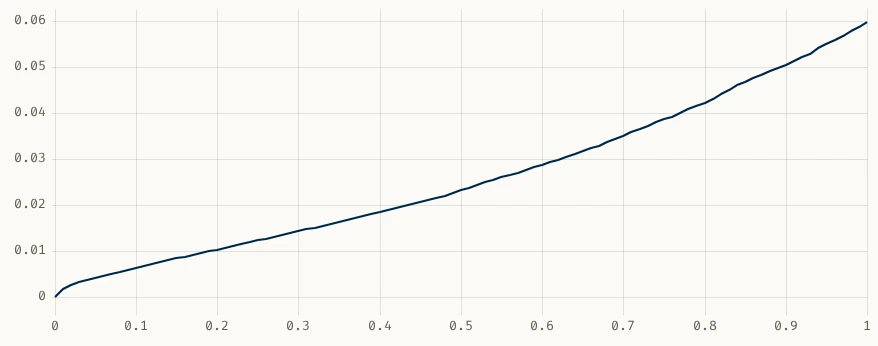
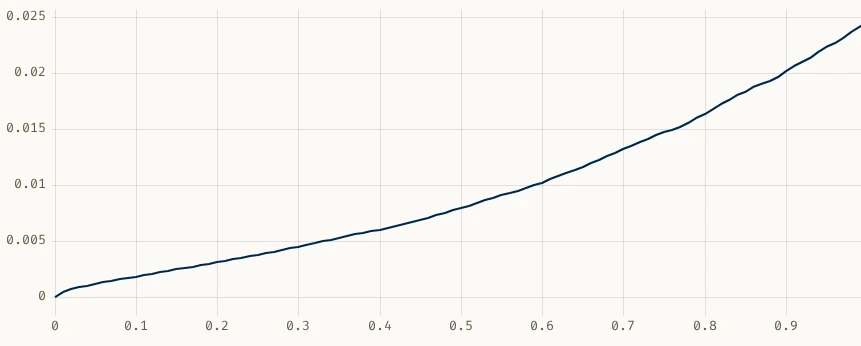
Strong (pathwise) error on the same Brownian path
For geometric Brownian motion $dX_t = \mu X_t\,dt + \sigma X_t\,dW_t$ with $\mu = 1$, $\sigma = 0.5$, and $T = 1$, we track $dw_t = dW_t$ as an auxiliary state so the analytical solution on the exact same driving noise can be evaluated at $T$:
$$X(T) = x_0 \exp\Bigl(\bigl(\mu - \frac{\sigma^2}{2}\bigr)T + \sigma W_T\Bigr)$$The strong error $\mathbb{E}|X_N - X(T)|$ measures path-by-path proximity (sampling error $1\%$ to $3\%$):
| Step count | Euler–Maruyama | Milstein |
|---|---|---|
| $100$ steps | $4.0 \times 10^{-2}$ | $1.6 \times 10^{-2}$ |
| $10^3$ steps | $1.2 \times 10^{-2}$ | $1.6 \times 10^{-3}$ |
| Error ratio | $3.3$ | $9.9$ |
| Fitted convergence order | $0.51$ | $1.00$ |
Weak error of the expectation
With $\sigma = 0.1$, $\mu = 2$, $T = 1$, and $100$ steps, Milstein adds $\frac{1}{2}\sigma^2 X_n\bigl((\Delta W_n)^2 - \Delta\bigr)$ at every step. Since $\mathbb{E}[(\Delta W_n)^2 - \Delta] = 0$, the expected update under both Euler and Milstein is identical:
$$\mathbb{E}[X_n] = (1 + \mu\Delta)^n x_0$$At $n = 100$ ($\Delta = 0.01$), both schemes yield $(1.02)^{100} = 7.245$ versus exact $e^2 = 7.389$—the exact same $-1.95\%$ weak bias (SE $7 \times 10^{-3}$), confirming weak order $1$ ($\mathcal{O}(\Delta)$) for both.
Run this in sItô
Open sItô with this model pre-loaded to inspect the path distribution, summary statistics, and parameter sensitivities—or change any setting and rerun:
- Open Euler strong error (100 steps) in sItô ↗ — strong error near $4.0 \times 10^{-2}$.
- Open Euler strong error (1,000 steps) in sItô ↗ — strong error drops roughly threefold to $1.2 \times 10^{-2}$.
- Open Milstein strong error (100 steps) in sItô ↗ — strong error near $1.6 \times 10^{-2}$.
- Open Milstein strong error (1,000 steps) in sItô ↗ — strong error falls tenfold to $1.6 \times 10^{-3}$.
- Open Euler weak bias in sItô ↗ — mean converges to $(1.02)^{100} = 7.245$ instead of $e^2 = 7.389$.
- Open Milstein weak bias in sItô ↗ — matches Euler’s weak mean ($7.245$) despite strong order $1$.
For higher-dimensional SDEs where Milstein requires iterated Lévy areas, see the note on several noises. Solver requirements are summarized in the sItô Reference, and the scheme derivations in Compiling parametric SDEs into fast Monte Carlo simulations.
Related notes: Monte Carlo error versus discretization error · Euler on a stiff mean reversion