A noisy van der Pol oscillator loses phase coherence without shrinking in amplitude. Each individual trajectory remains attracted to the limit cycle, so $\mathbb{E}[x_t^2]$ holds steady, while random kicks accumulate in phase and pull the ensemble mean $\mathbb{E}[x_t]$ toward zero.
Separating phase decoherence from damping
Consider the stochastically forced oscillator with $\mu = 1$, $\omega = 2\pi$, and initial displacement $x_0 = 0.5$:
$$dx_t = v_t\,dt, \qquad dv_t = \bigl(\mu(1 - x_t^2)v_t - \omega^2 x_t\bigr)\,dt + \sigma\,dW_t$$Around a stable limit cycle, amplitude perturbations are restored rapidly, while phase perturbations experience neutral stability and diffuse freely [1, 2]: $\varphi_t = \varphi_0 + \omega t + \sqrt{2D}\,W_t$. Consequently, the ensemble average of a periodic observable decays exponentially as $e^{-Dt}$ (defining the coherence time $\frac{1}{D}$), even though each path maintains full cycle energy.
Simulated to $T = 10$ across $10^3$ paths:
| Noise $\sigma$ | $\mathbb{E}[x_{10}]$ (SE) | $\mathbb{E}[x_{10}^2]$ | Ratio $\frac{\lvert\mathbb{E}[x_{10}]\rvert}{\operatorname{rms}}$ | Reference ratio (larger $N$) |
|---|---|---|---|---|
| $3$ | $1.44$ ($0.06$) | $3.28$ | $0.79$ | $0.81$ |
| $6$ | $0.46$ | $2.84$ | $0.27$ | $0.35$ |
Doubling the noise intensity quadruples the phase diffusion constant $D$, collapsing the coherence ratio from $0.81$ down to $0.35$ at $t = 10$ while $\mathbb{E}[x_{10}^2]$ stays near $3$.
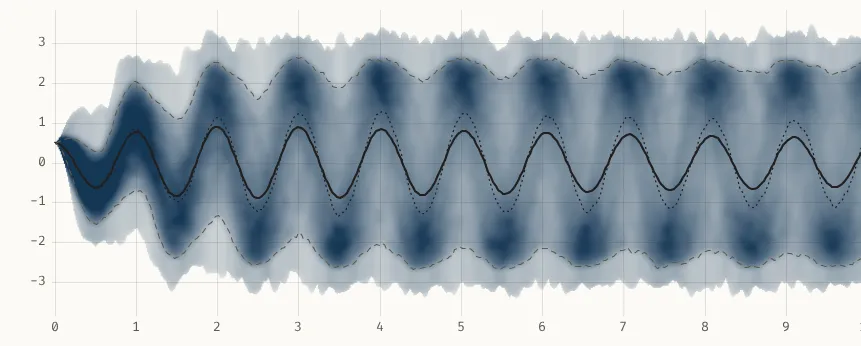
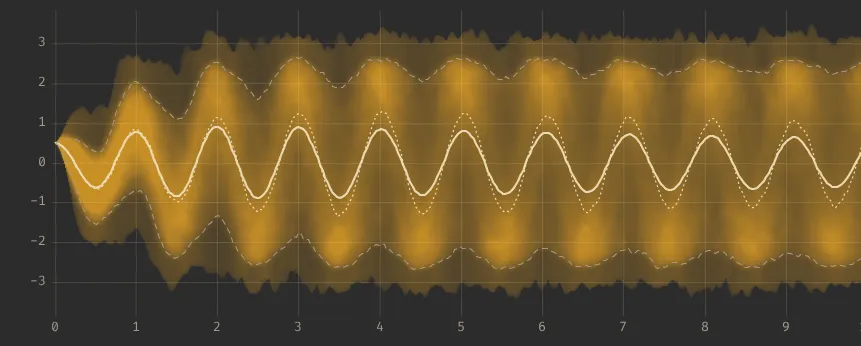
Run this in sItô
Open sItô with this model pre-loaded to inspect the path distribution, summary statistics, and parameter sensitivities—or change any setting and rerun:
- Open mild noise (σ = 3) in sItô ↗ — paths stay roughly clustered in phase through $T = 10$ ($|\text{mean}|$ near $80\%$ of RMS).
- Open strong noise (σ = 6) in sItô ↗ — phase spread washes out most of the ensemble mean while preserving cycle amplitude.
Discretization check across step sizes
Refining the time step $\Delta$ checks how much of the amplitude or coherence comes from the Euler grid:
| Step $\Delta$ | RMS ($\sigma = 3$) | Coherence ratio ($\sigma = 3$) | Coherence ratio ($\sigma = 6$) |
|---|---|---|---|
| $0.01$ | $1.83$ | $0.81$ | $0.35$ |
| $5 \times 10^{-3}$ | $1.73$ | $0.83$ | $0.35$ |
| $2.5 \times 10^{-3}$ | $1.66$ | $0.81$ | $0.33$ |
Euler’s forward step inflates the cycle radius by roughly $10\%$ at $\Delta = 0.01$, whereas the dimensionless coherence ratio remains consistent across grids.
For a chaotic system whose trajectories diverge exponentially in amplitude as well as phase, see predictability in the Lorenz system. Coupled SDE systems are documented in Compiling parametric SDEs into fast Monte Carlo simulations.
Related notes: Euler on a stiff mean reversion · float32 against float64