Four classical short-rate models [1, 2] separate cleanly along three practical axes: whether rates can turn negative, the terminal distribution of $r_T$, and whether zero-coupon bond prices have closed forms.
Comparison of the four dynamics
| Model | SDE ($dr_t$) | Law of $r_T$ | Negative rates | Bond formula |
|---|---|---|---|---|
| Vasicek | $a(b - r_t)\,dt + \sigma\,dW_t$ | Normal | Yes | Closed form (affine) |
| CIR | $a(b - r_t)\,dt + \sigma\sqrt{r_t}\,dW_t$ | Non-central $\chi^2$ | No | Closed form (affine) |
| Hull–White | $\bigl(\theta(t) - a r_t\bigr)\,dt + \sigma\,dW_t$ | Normal | Yes | Closed form (affine) |
| Black–Karasinski | $d\ln r_t = \bigl(\theta(t) - a\ln r_t\bigr)\,dt + \sigma\,dW_t$ | Log-normal | No | Numerical only |
With $a = 0.8$, $b = 4\%$, and $r_0 = 3\%$, both Vasicek and CIR share the same linear drift and therefore the same one-year expected rate $b + (r_0 - b)e^{-a} = 3.55\%$. Choosing Vasicek $\sigma = 2\%$ gives standard deviation $1.41\%$, while CIR with $\sigma = 0.1$ gives $1.30\%$ and satisfies Feller’s positivity condition $2ab \ge \sigma^2$ ($0.064 \ge 0.010$).
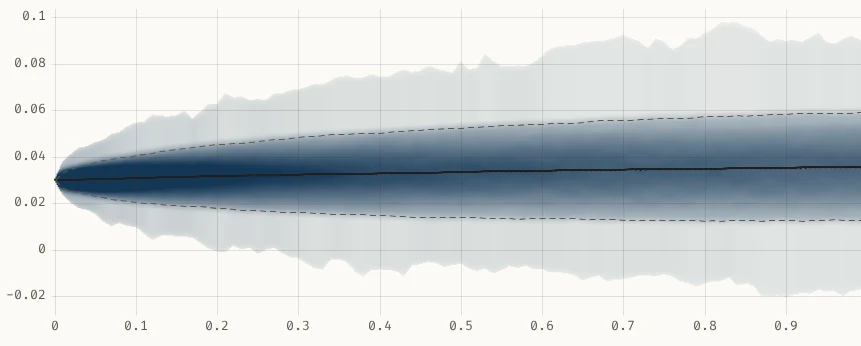
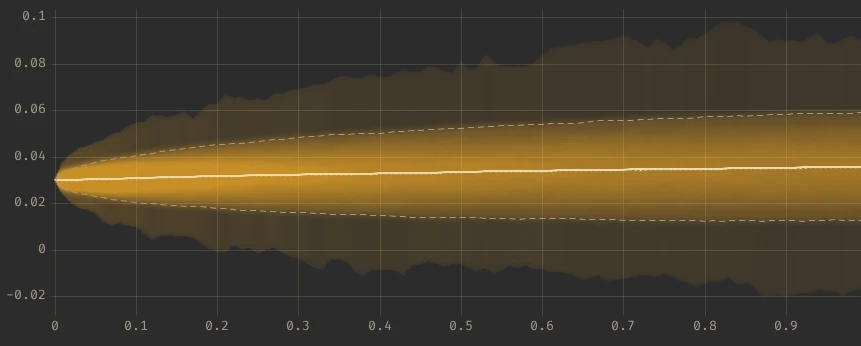
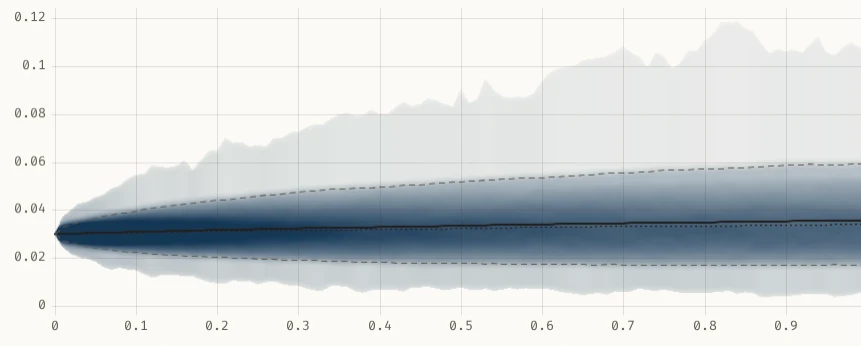
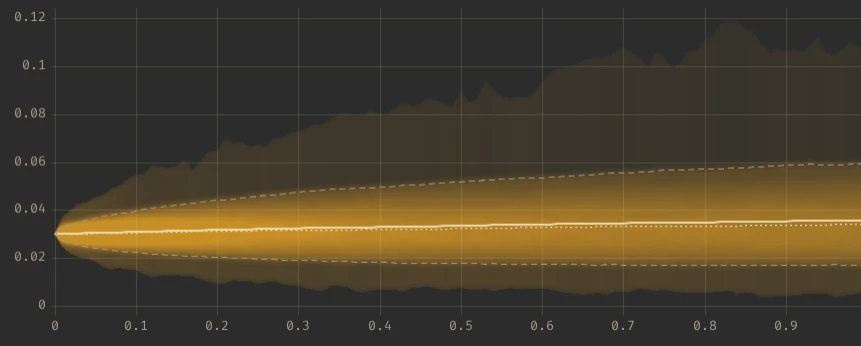
Run this in sItô
Open sItô with this model pre-loaded to inspect the path distribution, summary statistics, and parameter sensitivities—or change any setting and rerun:
- Open Vasicek short rate in sItô ↗
- Open CIR short rate in sItô ↗
- Open gallery Hull–White model in sItô ↗
- Open gallery Black–Karasinski model in sItô ↗
| Model ($T = 1$) | Mean $r_1$ | Standard deviation | $\mathbb{P}(r_1 < 0)$ |
|---|---|---|---|
| Vasicek | 3.55% | 1.41% | 0.6% (SE $8 \times 10^{-4}$) |
| CIR | 3.55% | 1.30% | 0% |
| Hull–White (gallery) | 3.82% (rising $\theta(t)$) | — | Yes |
| Black–Karasinski (gallery) | 3.56% ($\ln r_1 \sim \mathcal{N}(-3.386, 0.101)$, $e^{m + \frac{v}{2}}$) | — | 0% |
Trade-offs in calibration
Gaussian models allow negative rates—long viewed as a flaw until negative policy rates appeared in 2014—while keeping exact affine bond formulas and tractability. CIR enforces non-negativity within an affine structure at the cost of square-root dynamics near zero, whereas Black–Karasinski delivers positive log-normal rates while giving up analytical bond pricing. Affine bond pricing via rate integration is derived in The zero-coupon bond by Feynman–Kac, and the simulation pipeline in Compiling parametric SDEs into fast Monte Carlo simulations.
Related notes: The Feller condition for CIR, Normal against log-normal models.