With a single driving Brownian motion, Milstein requires only the diagonal iterated integral $\frac{1}{2}\bigl((\Delta W)^2 - \Delta\bigr)$. With two or more Brownian motions, the Milstein expansion introduces mixed double integrals containing the Lévy stochastic area, which cannot be written as functions of the step increments alone.
The Lévy area and commutative noise
For two independent Brownian motions $W^1$ and $W^2$, the cross iterated integral decomposes into a symmetric increment product plus an antisymmetric Lévy area $A_{12}$:
$$ \begin{aligned} I_{(1, 2)} &= \int_{t_n}^{t_{n+1}} \int_{t_n}^{s} dW^1_r\,dW^2_s = \frac{1}{2}\Delta W^1\Delta W^2 + A_{12}, \\ A_{12} &= \frac{1}{2}\int_{t_n}^{t_{n+1}} \bigl((W^1_s - W^1_{t_n})\,dW^2_s - (W^2_s - W^2_{t_n})\,dW^1_s\bigr). \end{aligned} $$Simulating $A_{12}$ requires additional random draws beyond $\Delta W^1$ and $\Delta W^2$ [2]. The full Milstein correction is $\sum_{j_1, j_2} L^{j_1} b^{j_2}\,I_{(j_1, j_2)}$ [1]: whenever the noise commutes—meaning $L^{j_1} b^{j_2} = L^{j_2} b^{j_1}$ for all pairs—the antisymmetric areas $A_{j_1 j_2} = -A_{j_2 j_1}$ cancel identically, leaving only $\frac{1}{2}\Delta W^{j_1}\Delta W^{j_2}$ and achieving strong order $1.0$. For two-factor geometric Brownian motion $dX_t = \mu X_t\,dt + X_t(\sigma_1\,dW^1_t + \sigma_2\,dW^2_t)$, both cross coefficients equal $\sigma_1\sigma_2 X_t$, so the noise commutes.
Run this in sItô
Open sItô with this model pre-loaded to inspect the path distribution, summary statistics, and parameter sensitivities—or change any setting and rerun (with $\mu = 1, \sigma_1 = 0.4, \sigma_2 = 0.3$ and auxiliary Brownian states $w_1, w_2$ giving the pathwise exact reference $x_0 \exp\bigl((\mu - \frac{\sigma_1^2 + \sigma_2^2}{2})t + \sigma_1 w_1 + \sigma_2 w_2\bigr)$):
- Open two-noise GBM, Euler ($100$ steps) in sItô ↗
- Open two-noise GBM, Euler ($10^3$ steps) in sItô ↗
- Open two-noise GBM, Milstein (refused example) in sItô ↗
- Open diagonal-noise Milstein ($10^3$ paths) in sItô ↗
| Setup | Scheme | Result |
|---|---|---|
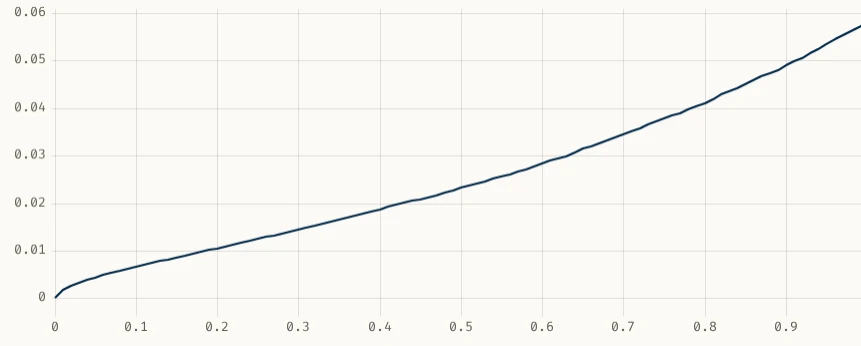
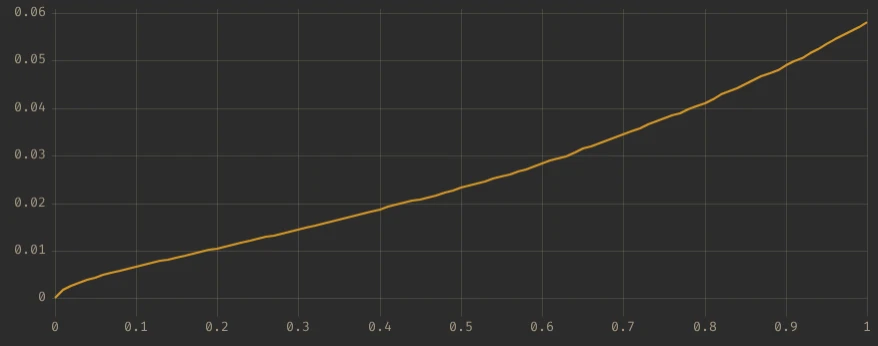
| Two-noise GBM ($100$ steps) | Euler | Mean absolute path error $4.0 \times 10^{-2}$ |
| Two-noise GBM ($10^3$ steps) | Euler | Mean absolute path error $1.2 \times 10^{-2}$ (ratio $3.3 \approx \sqrt{10}$) |
| Two-noise GBM ($100$ steps) | Milstein | Refused (sItô does not supply mixed integrals in the demo) |
| Diagonal two-state system | Milstein | Runs cleanly ($\mathbb{E}[x] = (1 + \mu\Delta)^n = 1.0513$; run: $1.057$) |
Practical choices in multi-factor SDEs
sItô runs Euler and Weak Euler for any number of Brownian drivers, and restricts Milstein and higher strong schemes to scalar or diagonal noise where each state depends only on its own Brownian motion and no cross integral appears. In general non-commutative multi-factor models, strong convergence with Euler remains order $\frac{1}{2}$ unless mixed iterated integrals or Lévy-area approximations are supplied externally; see Weak and strong convergence, scheme applicability in the sItô Reference, and Compiling parametric SDEs into fast Monte Carlo simulations.
Related notes: Correlated assets, Euler on a stiff mean reversion.