For European options on a non-dividend-paying asset, put–call parity [1, 2] links the call price $C$ and put price $P$ to the discounted forward:
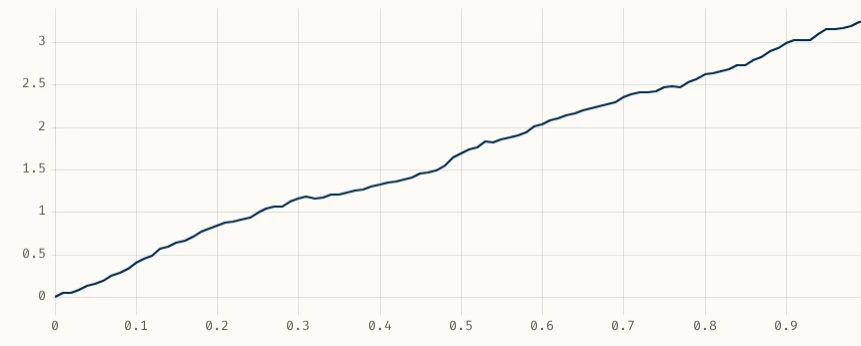
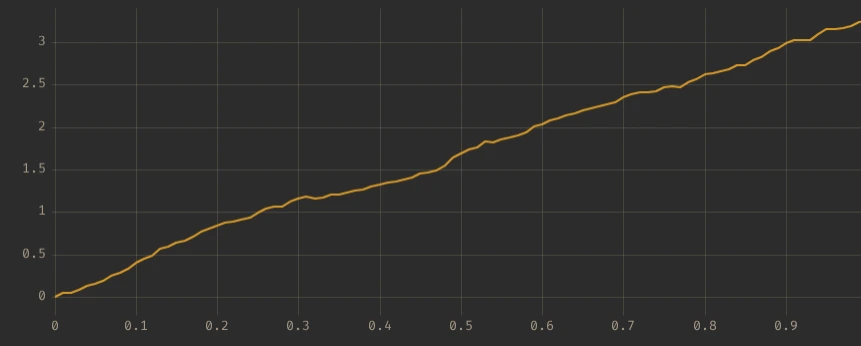
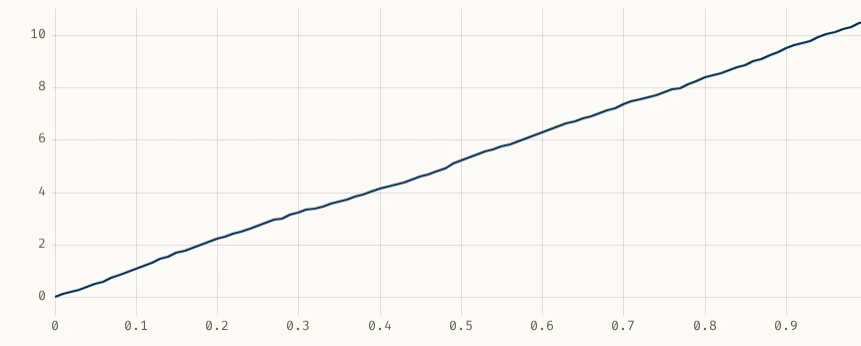
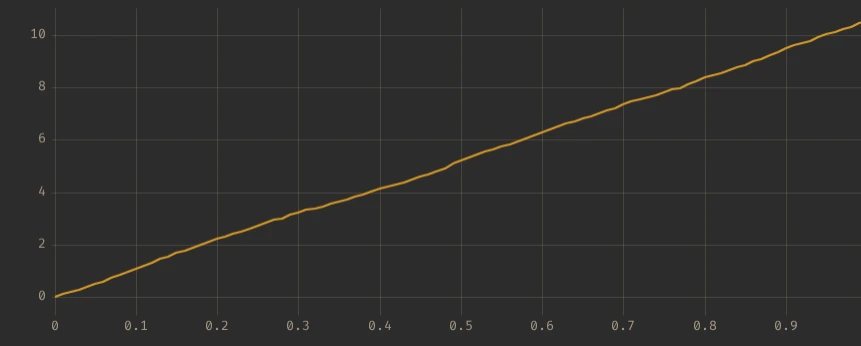
$$ C - P = S_0 - K e^{-rT}. $$With $S_0 = K = 100$, $r = 3\%$, and $T = 1$, parity fixes $C - P = 2.955$ regardless of the volatility model. A simulator that uses a $10\%$ physical drift while discounting at $3\%$ breaks this identity immediately, reporting $C - P \approx 10.2$.
Two independent checks in one identity
Put–call parity separates payoff/discounting bugs from drift bugs at two levels:
- Pathwise payoff check: Because $(S_T - K)^+ - (K - S_T)^+ = S_T - K$ holds algebraically on every trajectory, the discounted residual $c - p - e^{-rT}(S_T - K)$ vanishes path by path (up to floating-point rounding near $10^{-6}$). Any non-zero pathwise residual points to a bug in payoff evaluation or discounting.
- Expectation drift check: Taking expectations gives $\mathbb{E}[e^{-rT}(S_T - K)] = S_0 - K e^{-rT}$ if and only if $\mathbb{E}[S_T] = S_0 e^{rT}$, testing directly whether the simulated dynamics carry the risk-neutral drift $r$ without needing any analytical option formula.
Because parity reduces to the underlying asset, the standard error of $C - P$ equals $e^{-rT}\frac{\mathrm{sd}[S_T]}{\sqrt{N}} = 0.22$ over $10^4$ paths—larger than the $0.14$ standard error of a single call price.
Run this in sItô
Open sItô with this model pre-loaded to inspect the path distribution, summary statistics, and parameter sensitivities—or change any setting and rerun:
- Open risk-neutral run ($\mu = r = 3\%$) in sItô ↗
- Open mismatched drift ($\mu = 10\%, r = 3\%$) in sItô ↗
| Run ($S_0 = K = 100, r = 3\%, T = 1$) | Simulated $C - P$ | Exact parity ($2.955$) | Discrepancy |
|---|---|---|---|
| $\mu = 3\%$ (risk-neutral) | $\approx 2.96$ (call $9.41$, put $6.46$) | $2.96$ | Within $1\text{ SE}$ ($0.22$) |
| $\mu = 10\%$ (mismatched drift) | $\approx 10.2$ | $2.96$ | $33$ standard errors |
What parity leaves untested
Because $S_0 - K e^{-rT}$ does not depend on volatility, parity cannot detect a misspecified $\sigma$ or an erroneous diffusion matrix whenever call and put prices shift by the same offset. Checking volatility requires an analytical price benchmark such as Black–Scholes by simulation or Correlated assets. The underlying simulation pipeline is described in Compiling parametric SDEs into fast Monte Carlo simulations.
Related notes: Common random numbers.