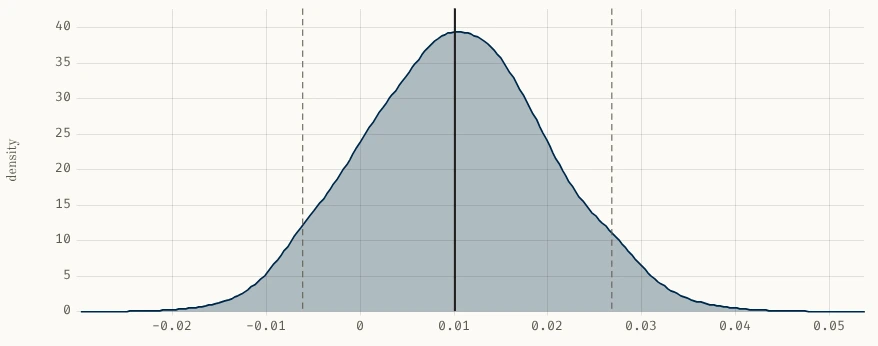
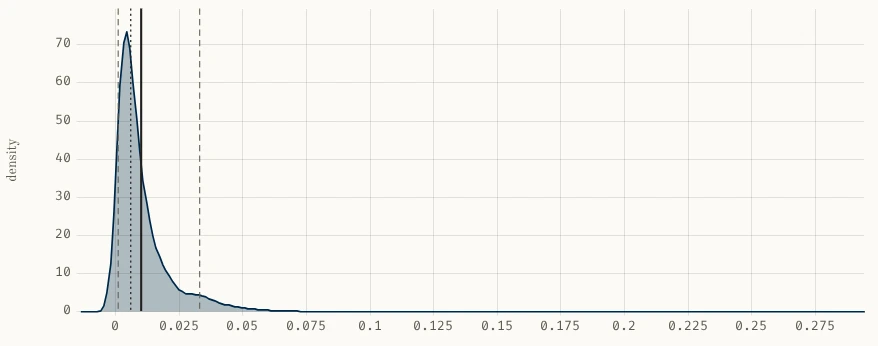
Three martingale models of a forward rate $F_t$ calibrated to the same at-the-money normal volatility produce nearly identical at-the-money call prices yet diverge sharply near zero. With $F_0 = 1\%$ and $100\text{ bps}$ normal volatility over one year, $15.9\%$ of Bachelier paths and $15.5\%$ of displaced-diffusion paths finish negative, whereas Black’s model forbids negative rates altogether.
Model dynamics and volatility matching
| Model | SDE ($dF_t$) | Terminal distribution | Support |
|---|---|---|---|
| Bachelier | $\sigma_N\,dW_t$ | Normal | $(-\infty, +\infty)$ |
| Black | $\sigma F_t\,dW_t$ | Log-normal | $(0, +\infty)$ |
| Displaced diffusion | $\sigma(F_t + d)\,dW_t$ | $F_T + d$ log-normal | $(-d, +\infty)$ |
Each is a martingale with $\mathbb{E}[F_T] = F_0 = 0.01$. Matching local volatility at $F_0 = 1\%$ sets $\sigma_N = 1\%$ for Bachelier, $\sigma = 1.0$ for Black ($\sigma F_0 = 1\%$), and displacement $d = 4\%$ with $\sigma = 0.2$ for displaced diffusion ($\sigma(F_0 + d) = 1\%$).
Run this in sItô
Open sItô with this model pre-loaded to inspect the path distribution, summary statistics, and parameter sensitivities—or change any setting and rerun (each run reports $\mathbb{E}[F_1] \approx 0.01$, the negative-rate share with SE $3.6 \times 10^{-3}$, and the call and floor prices with SE $3 \times 10^{-5}$ to $10^{-4}$):
- Open Bachelier model in sItô ↗
- Open Black model in sItô ↗
- Open displaced diffusion ($d = 4\%$) in sItô ↗
| Metric at $T = 1$ | Bachelier | Black | Displaced ($d = 4\%$) |
|---|---|---|---|
| $\mathbb{P}(F_1 < 0)$ | 15.87% | 0% | 15.49% |
| ATM call $\mathbb{E}[(F_1 - 0.01)^+]$ | $3.99 \times 10^{-3}$ | $3.83 \times 10^{-3}$ | $3.98 \times 10^{-3}$ |
| Zero-strike floor $\mathbb{E}[(-F_1)^+]$ | $8.33 \times 10^{-4}$ | 0 | $5.93 \times 10^{-4}$ |
While all three agree within $4\%$ on the at-the-money call ($\approx 39\text{ bps}$), a zero-strike floor costs $8.33\text{ bps}$ under Bachelier, $5.93\text{ bps}$ under displaced diffusion, and $0$ under Black.
Choosing a rate convention
When rates can cross zero without a hard lower bound, Bachelier’s normal model is the standard desk convention. When a finite floor $-d$ is required, displaced diffusion keeps shifted log-normality down to $-d$ [1, 2]. For strictly positive short-rate dynamics such as CIR, see Short-rate models compared and Compiling parametric SDEs into fast Monte Carlo simulations.
Related notes: CEV local volatility, SABR and the Hagan expansion.