Scope note: This note uses a stylized textbook SDE with dimensionless parameters as a standard stochastic-modeling illustration in sItô. It is not a calibrated physical, biological, or clinical model, and domain-specific noise mechanisms and empirical validation are outside its scope.
A FitzHugh–Nagumo [1, 2] neuron biased below its firing threshold remains quiescent in the absence of noise, yet stochastic fluctuations in membrane voltage can push it across the separatrix and trigger a full action potential. Over a window of $T = 10$ time units, doubling the noise amplitude from $\sigma = 0.15$ to $\sigma = 0.3$ raises the firing probability from $0.5\%$ to $67\%$.
Excitable stochastic dynamics
With time-scale separation $c = 15$, recovery ratio $\varepsilon = 0.08$, and sub-threshold input current $I = 0.2$, the noisy FitzHugh–Nagumo SDE is
$$ \begin{aligned} dv_t &= c\Bigl(v_t - \frac{v_t^3}{3} - w_t + I\Bigr)\,dt + \sigma\,dW_t, \\ dw_t &= c\,\varepsilon\,(v_t + 0.7 - 0.8\,w_t)\,dt. \end{aligned} $$Deterministically ($\sigma = 0$), the system sits at a stable equilibrium $(v, w) = (-1.069, -0.462)$. A fluctuation exceeding the excitability threshold sends $v_t$ on a large excursion near $+2$ before refractory recovery returns it to rest; counting $\max_{0 \le t \le T} v_t > 1$ isolates these firing events. Because crossing requires a rare noise excursion, the expected waiting time scales exponentially in $\sigma^{-2}$ as in Kramers escape, producing a sharp threshold transition over a fixed window.
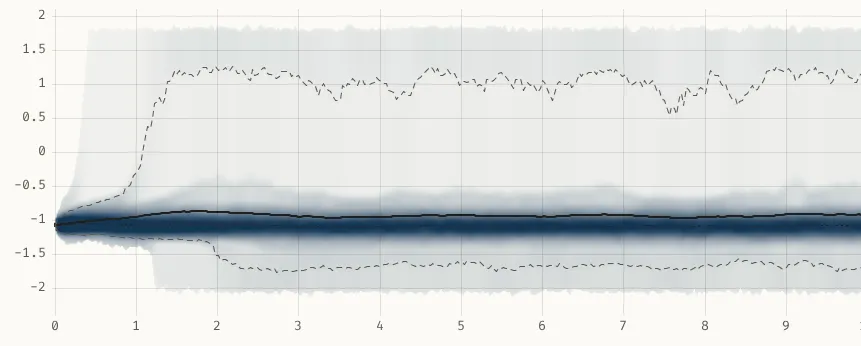
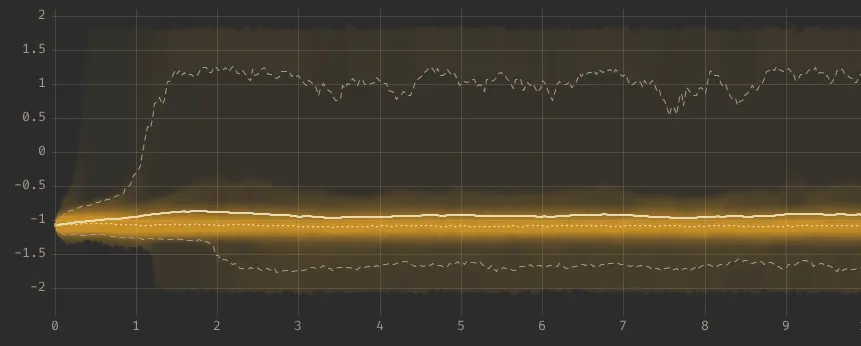
Run this in sItô
Open sItô with this model pre-loaded to inspect the path distribution, summary statistics, and parameter sensitivities—or change any setting and rerun (each run simulates $10^3$ paths to $T = 10$ from the resting equilibrium):
- Open FitzHugh–Nagumo ($\sigma = 0.15$) in sItô ↗
- Open FitzHugh–Nagumo ($\sigma = 0.2$) in sItô ↗
- Open FitzHugh–Nagumo ($\sigma = 0.3$) in sItô ↗
| Noise $\sigma$ | Spike probability $\mathbb{P}(\max v > 1)$ | Standard error |
|---|---|---|
| 0.15 | 0.5% | Handful of $10^3$ paths |
| 0.20 | 10% | 1% |
| 0.30 | 67% | 1.5% |
Beyond single-spike probability
At an intermediate noise strength, inter-spike intervals become maximally regular—a phenomenon known as coherence resonance. Detecting that regularity requires the distribution of waiting times between consecutive spikes rather than the binary threshold crossing measured here. The underlying discretization schemes are described in Compiling parametric SDEs into fast Monte Carlo simulations.
Related notes: Phase diffusion in the van der Pol oscillator, Estimating small probabilities by Monte Carlo.