For a one-dimensional gradient diffusion $dX_t = -V'(X_t)\,dt + \sigma\,dW_t$, the stationary density is proportional to $\exp\bigl(-\frac{2V(x)}{\sigma^2}\bigr)$. Under the symmetric double-well potential $V(x) = -a\bigl(\frac{x^2}{2} - \frac{x^4}{4}\bigr)$, this yields the bimodal invariant law
$$ p(x) \propto \exp\Bigl(\frac{a\bigl(x^2 - \frac{x^4}{2}\bigr)}{\sigma^2}\Bigr). $$Derivation from Fokker–Planck
In steady state, the Fokker–Planck equation [1] requires $0 = \partial_x\bigl(V' p\bigr) + \frac{\sigma^2}{2}\,\partial_x^2 p$. Because a confining potential admits no probability current at infinity, the probability flux vanishes identically:
$$ V'(x)\,p(x) + \frac{\sigma^2}{2}\,p'(x) = 0 \implies p(x) \propto e^{-\frac{2V(x)}{\sigma^2}}, $$where $\frac{\sigma^2}{2}$ plays the role of temperature in the Boltzmann factor [2]. With $a = 4$, the two minima lie at $x = \pm 1$ and the barrier height at $x = 0$ is $\Delta V = \frac{a}{4} = 1$. At noise level $\sigma = 0.7$, the density ratio between barrier peak and well bottom is $e^{-\frac{2\Delta V}{\sigma^2}} = e^{-4.08} \approx 0.017$, and numerical integration gives the stationary second moment $\mathbb{E}[X^2] = 0.9195$.
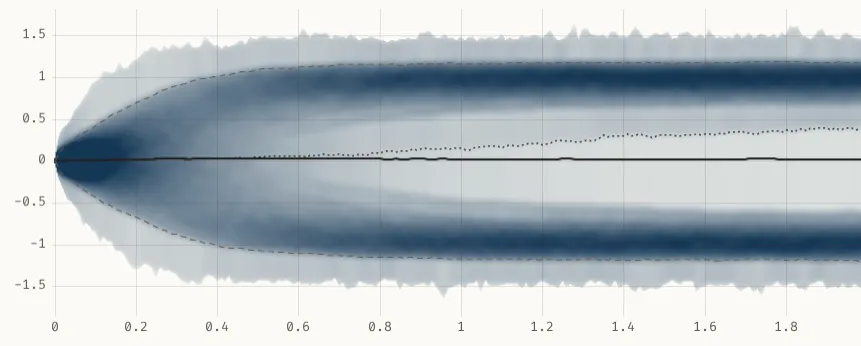
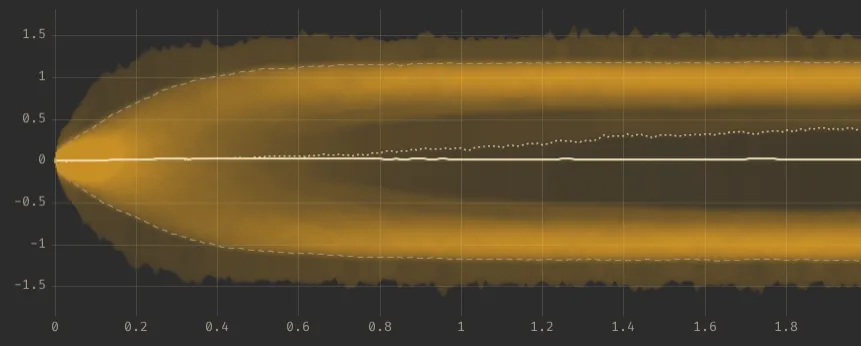
Run this in sItô
Open sItô with this model pre-loaded to inspect the path distribution, summary statistics, and parameter sensitivities—or change any setting and rerun:
- Open double-well diffusion from the barrier ($T = 2$) in sItô ↗. Starting at $x_0 = 0$ preserves symmetry, placing $0.5$ of paths in each well (within $0.02$) and yielding $\mathbb{E}[X_2^2] \approx 0.92$ (within sampling error $0.02$).
Two relaxation time scales
Two distinct time scales govern the convergence. Within each well, the local curvature $V''(\pm 1) = 2a = 8$ relaxes fluctuations at rate $8$, so by $T = 2$ the intra-well distribution is stationary. Transitions across the barrier, by contrast, occur at a rate proportional to $e^{-\frac{2\Delta V}{\sigma^2}} \approx 0.017$, so paths have not equilibrated globally by $T = 2$; starting symmetrically on the barrier matches the exact 50/50 stationary split across the two wells anyway. The underlying simulation pipeline is described in Compiling parametric SDEs into fast Monte Carlo simulations.
Related notes: Bistable systems with noise, The Ornstein–Uhlenbeck process, Pitchfork with multiplicative noise.