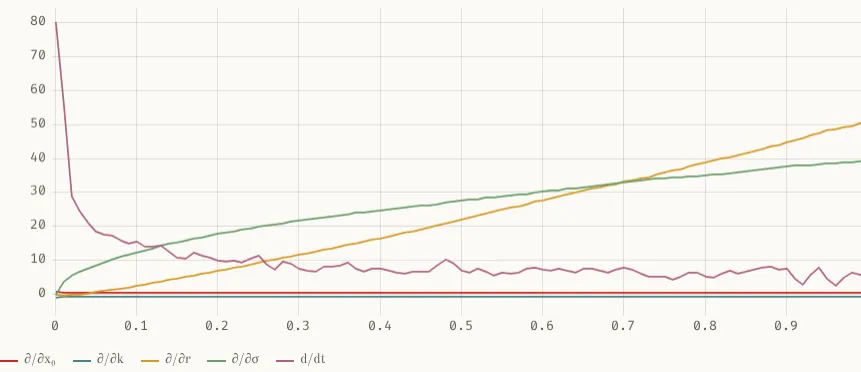
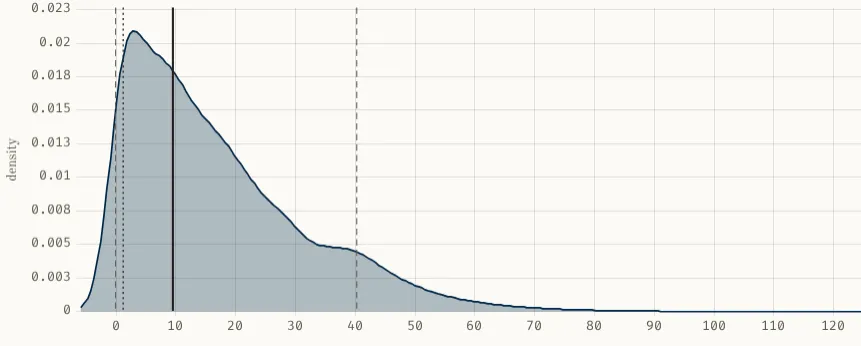
A European call under Black–Scholes with $S_0 = K = 100$, $r = 3\%$, $\sigma = 20\%$, and $T = 1$ has price $9.413$, delta $0.599$, vega $38.67$, and rho $50.46$. A single $10^4$-path simulation reproduces all four quantities—together with the strike derivative—within sampling error, providing a direct check against analytical values. Open Black–Scholes call ($10^4$ paths) in sItô ↗.
Closed-form reference values
Let $N(\cdot)$ and $\varphi(\cdot)$ denote the standard normal distribution and density functions, and define
$$ \begin{aligned} d_1 &= \frac{\ln\frac{S_0}{K} + \bigl(r + \frac{\sigma^2}{2}\bigr)T}{\sigma\sqrt{T}} = 0.25, \\ d_2 &= d_1 - \sigma\sqrt{T} = 0.05. \end{aligned} $$With these inputs, the Black–Scholes [1] call price and first-order sensitivities are:
| Quantity | Formula | Closed form | $3 \times \mathrm{SE}$ ($10^4$ paths) |
|---|---|---|---|
| Price $C$ | $S_0 N(d_1) - K e^{-rT} N(d_2)$ | 9.4134 | 0.45 |
| Delta $\frac{\partial C}{\partial S_0}$ | $N(d_1)$ | 0.5987 | 0.02 |
| Vega $\frac{\partial C}{\partial \sigma}$ | $S_0\,\varphi(d_1)\sqrt{T}$ | 38.667 | 2.3 |
| Rho $\frac{\partial C}{\partial r}$ | $K T e^{-rT} N(d_2)$ | 50.457 | 1.7 |
| Strike sensitivity $\frac{\partial C}{\partial K}$ | $-e^{-rT} N(d_2)$ | −0.5046 | 0.016 |
Pathwise simulation and sensitivities
Simulating geometric Brownian motion with drift r * x, diffusion sigma * x, and horizon $T = 1$, the discounted call payoff is $e^{-r}\max(x - k, 0)$. Differentiating the simulated pathwise payoff with respect to the initial state and each parameter produces the first-order Greeks in the same run; over $10^4$ paths, all five estimates fall within the $3 \times \mathrm{SE}$ bounds in the table above (up to a small time-discretization bias of order $\Delta$).
Under geometric Brownian motion, $S_T$ is homogeneous of degree one in $S_0$, so $\frac{\partial S_T}{\partial S_0} = \frac{S_T}{S_0}$. Differentiating $e^{-rT}(S_T - K)^+$ inside the expectation therefore yields the pathwise delta estimator $e^{-rT}\mathbf{1}_{\{S_T > K\}}\,\frac{S_T}{S_0}$, and automatic differentiation along the discretized scheme evaluates the vega, rho, and strike estimators analogously.
Run this in sItô
Open sItô with this model pre-loaded to inspect the path distribution, summary statistics, and parameter sensitivities—or change any setting and rerun:
Limits of pathwise differentiation
Second-order sensitivities such as gamma ($\frac{\partial^2 C}{\partial S_0^2}$) cannot be obtained by pathwise differentiation. Because $(S_T - K)^+$ is Lipschitz continuous, its first derivative exists almost everywhere and is bounded, allowing differentiation and expectation to commute [2]. Its first derivative, however, jumps at $S_T = K$, so differentiating a second time misses the Dirac mass at the strike and returns zero. Higher-order sensitivities require finite differences with common random numbers or likelihood-ratio weights. Comparing against this closed-form benchmark also catches specification errors such as a missing discount factor or a physical rather than risk-neutral drift; see put–call parity as a test, Parameter sensitivities in Using sItô, and Compiling parametric SDEs into fast Monte Carlo simulations.
Related notes: Delta hedging with discrete rebalancing, Pathwise Greeks and the digital payoff.