sItô compiles a system of stochastic differential equations into machine code for multi-core CPU and GPU execution. On commodity desktop hardware, generating normal random numbers dominates execution in low-dimensional models, accounting for 83% to 97% of CPU run time, while the drift expression, discretization scheme, and path statistic shift total run time by a few percent. The measurements below record compile and run times across path counts, step counts, state dimensions, schemes, statistics, and floating-point precision.
Hardware and protocol
All runs executed on one commodity desktop machine.
| Part | Description |
|---|---|
| CPU | Intel Core i9-13900K, 8 performance cores with two threads each and 16 efficiency cores, 36 MiB L3 cache |
| Memory | 64 GiB |
| GPU | NVIDIA GeForce RTX 4070 Ti, 12 GB, not used for display |
| System | Debian 13, kernel 6.12, governor powersave, turbo enabled |
Unless stated otherwise, CPU runs use one thread on each of four performance cores. The base model is geometric Brownian motion $\mathrm{d}X = \mu X\,\mathrm{d}t + \sigma X\,\mathrm{d}W$ with $\mu = 0.5$, $\sigma = 0.4$, and $X_0 = 1$ on $[0, 1]$, integrated with the Euler scheme in float32, reporting $\mathbb{E}[X_t]$ with seed 0. Each run starts in a fresh process once CPU and GPU utilization fall below 5% and temperatures sit at or below 70 °C on the CPU package and 60 °C on the GPU.
Compilation passes through four stages: symbolic differentiation and simplification, code generation, computation tracing, and backend lowering to machine code. Compile time is the sum of all four stages. Run time is the full invocation time after the initial call, including random-number generation, and every benchmark point reports the median of five warm runs. Repeating 64 configurations in a second process shifted the median by at most 2%, with a typical variation of 0.25%.
Because all random numbers are drawn before stepping in time, a CPU run allocates about 16 bytes per path, time step, and noise dimension, capping single-noise CPU sweeps at $10^9$ path-steps. In float32, GPU device memory requires 4.3 bytes per path-step and noise dimension.
Compile time
Compile time is independent of path and step counts. Across eight scalar and multi-state benchmark models—including expressions with sin, tanh, abs, and max—compile time stays between 0.26 and 0.32 s, rising to 1.7 s for a 20-state system with a full noise matrix. Lowering to machine code takes 0.1 s for one state and up to 0.5 s for five to ten states.
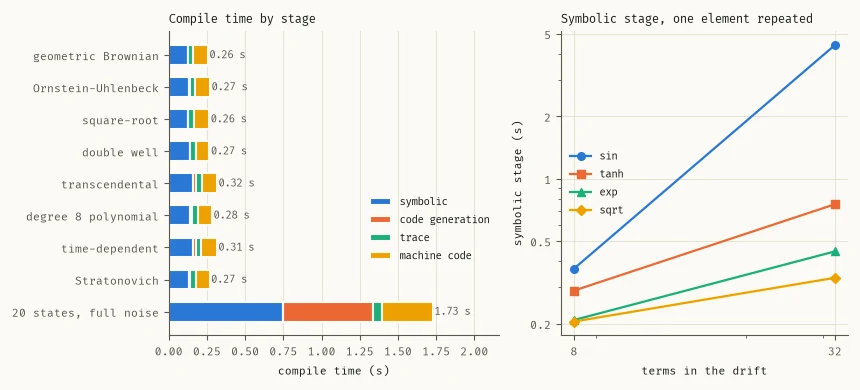
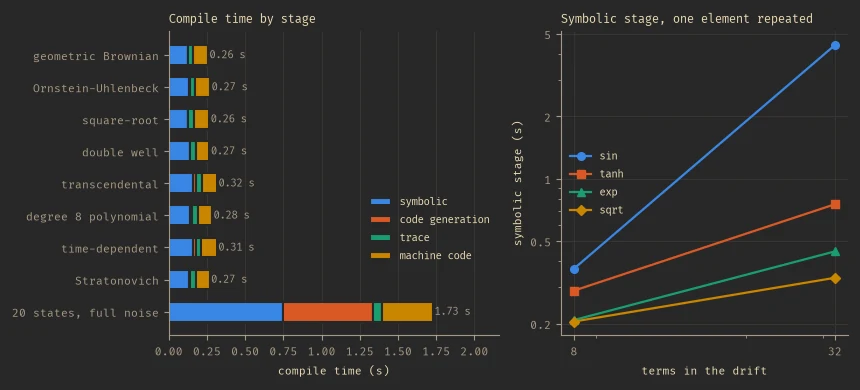
Symbolic simplification grows with the number of transcendental terms in the drift. Applying trigonometric and algebraic rewrite rules across nested expressions scales modestly for sqrt, exp, and tanh, and more steeply for sin.
| Drift | 8 terms | 32 terms |
|---|---|---|
sin | 0.37 s | 4.4 s |
tanh | 0.29 s | 0.75 s |
exp | 0.21 s | 0.45 s |
sqrt | 0.20 s | 0.33 s |
Run time and noise generation
On the CPU, run time scales linearly with the product of paths and steps. At $10^8$ path-steps, the base model takes 480 ms whether executed as $10^3$ paths by $10^5$ steps, $10^4$ by $10^4$, or $10^6$ by $10^2$, with $10^5$ by $10^3$ finishing in 476 ms.
| Paths $\times$ steps | CPU, ms | GPU, ms |
|---|---|---|
| $10^3 \times 10^5$ | 480 | 403 |
| $10^4 \times 10^4$ | 480 | 59 |
| $10^5 \times 10^3$ | 476 | 8.0 |
| $10^6 \times 10^2$ | 480 | 2.8 |
Per path-step, CPU throughput holds at 4.7 ns in float32 and 6.5 ns in float64. GPU timing depends on aspect ratio because paths execute in parallel while steps remain sequential. Across $10^8$ path-steps, the GPU outperforms the CPU by a factor of 170 at $10^6$ paths and 100 steps, narrowing to 1.2 at $10^3$ paths and $10^5$ steps. Below $10^7$ path-steps, kernel launch latency dominates GPU run time.
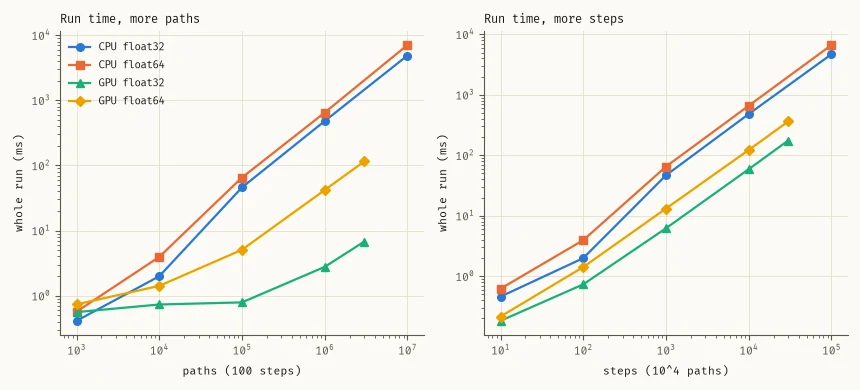
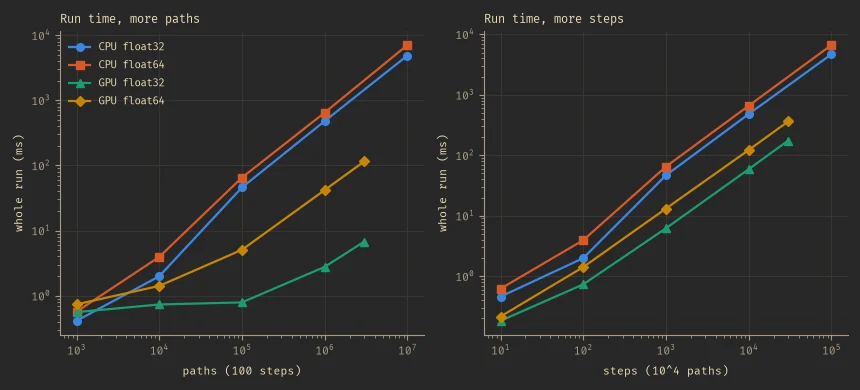
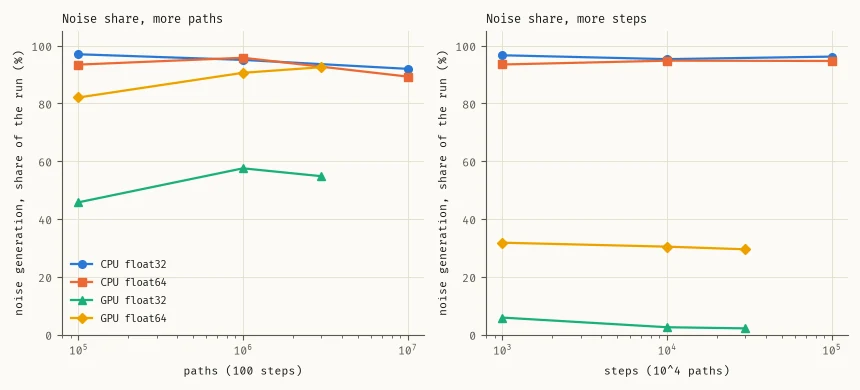
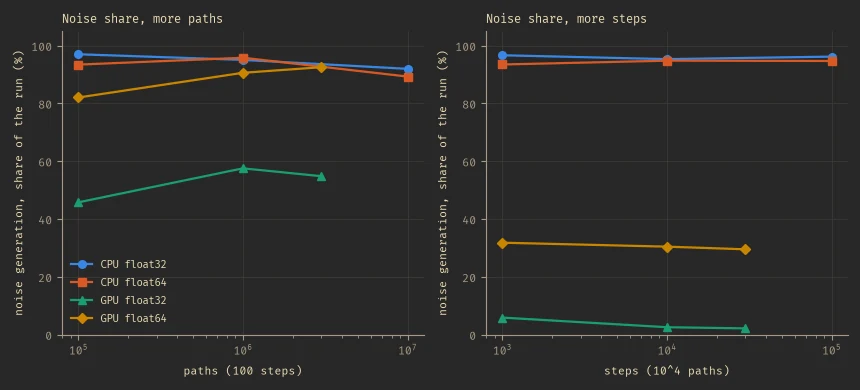
Isolating random-number generation from state updates quantifies the PRNG share of execution time. On the CPU, noise generation accounts for 83% to 97% of total time across all runs from $10^7$ path-steps upward. On the GPU, noise takes 46% to 58% of run time in float32 and over 80% in float64 when path counts are large, dropping to 2% to 6% when long sequential step loops dominate.
sItô uses a counter-based pseudorandom generator by default. Two faster reduced-state variants available in the numerical runtime were validated against normal marginals, Wiener increments, cross-seed correlation over 30 neighboring seeds, and exact Euler moments of the base model without detectable statistical discrepancy. Their hardware behavior diverges sharply between platforms.
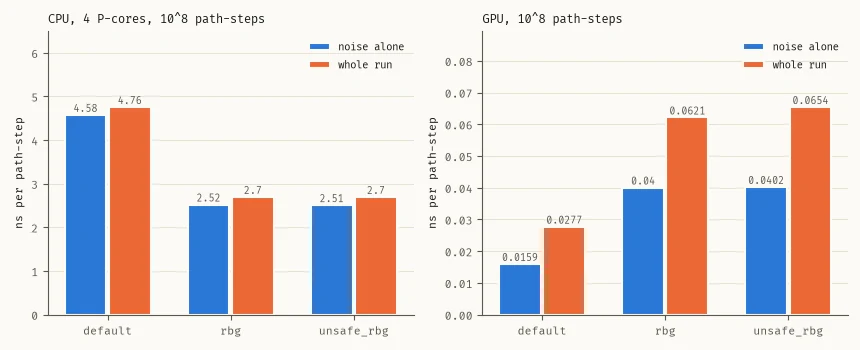
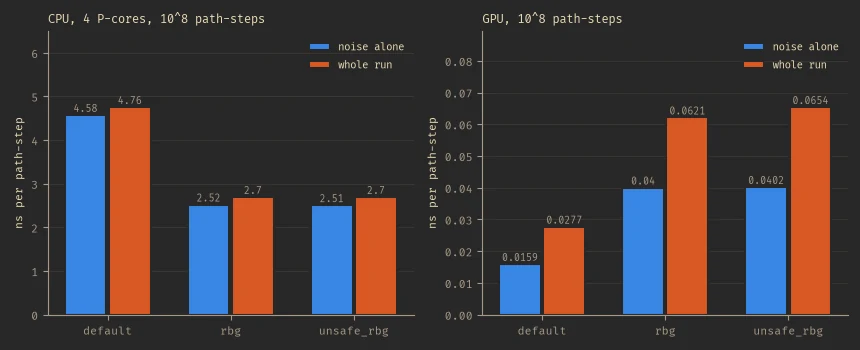
float32.On the CPU, the reduced-state generators lower whole-run cost from 4.7 ns to 2.7 ns per path-step, a factor of 1.8. On the GPU, they run slower than the counter-based default, taking 0.062 ns and 0.065 ns per path-step against 0.028 ns, factors of 2.2 and 2.4 slower. Retaining the counter-based default favors GPU execution and avoids hardware-specific divergence.
Number of states
Simulation cost rises with state dimension $d$ because each state requires independent noise and drift evaluation. Sweeps across coupled Ornstein–Uhlenbeck and Lorenz-96 systems with $d$ from 1 to 50 and 100 time steps differ by less than 10% across every tested size.
| States $d$ | CPU, ms | GPU, ms | CPU / GPU |
|---|---|---|---|
| 1 | 45.9 | 0.8 | 55 |
| 5 | 297 | 2.8 | 108 |
| 10 | 856 | 4.8 | 180 |
| 20 | 1,128 | 11.3 | 100 |
| 50 | 2,779 | 44.3 | 63 |
These figures correspond to $10^5$ paths in float32 with diagonal noise. CPU cost per path-step and state remains between 4.6 and 5.9 ns, with an outlier of 8.6 ns at $d = 10$. On the GPU, launch overhead keeps small-$d$ scaling sublinear. Switching from diagonal to a dense $d \times d$ noise matrix multiplies GPU cost by 1.1 at $d = 2$ and 3.6 at $d = 20$, while multiplying CPU cost by 1.1 at $d = 20$. At $d = 50$ with dense noise, the GPU finishes in 460 ms against 4.2 s on the CPU, a ratio of 9.
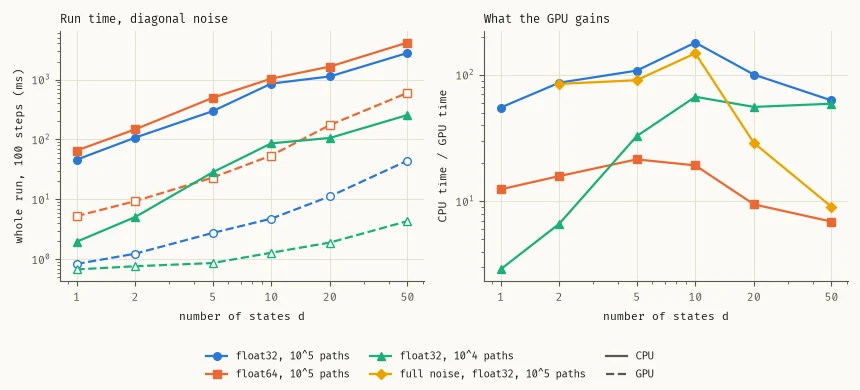
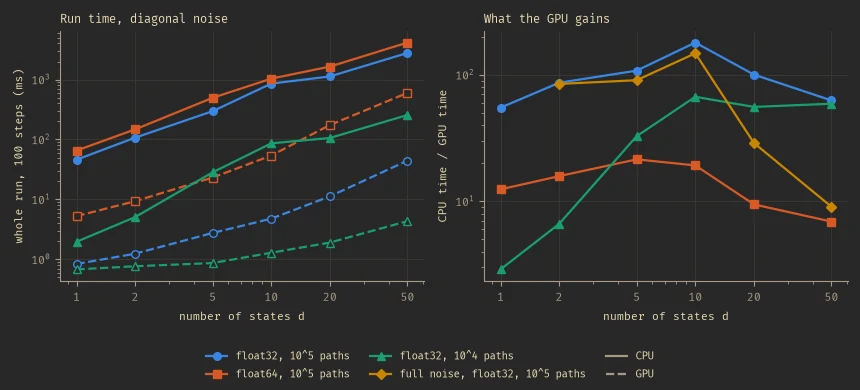
In float64, the GPU advantage shrinks to factors of 12 to 21 for $d \le 10$ and 6 to 9 for $d = 20$ and $d = 50$. Double precision slows the GPU by factors of 6 to 17 overall—15 at one state with many paths—while slowing the CPU by factors of 1.3 to 1.7.
Cores
Thread scaling was measured across a fixed workload of $2 \times 10^8$ path-steps.
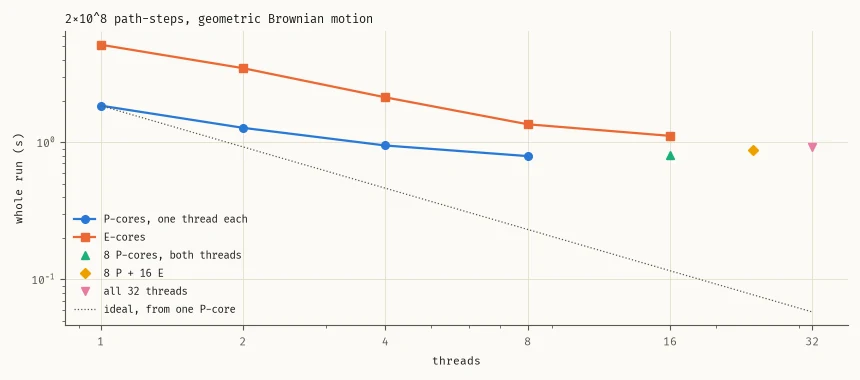
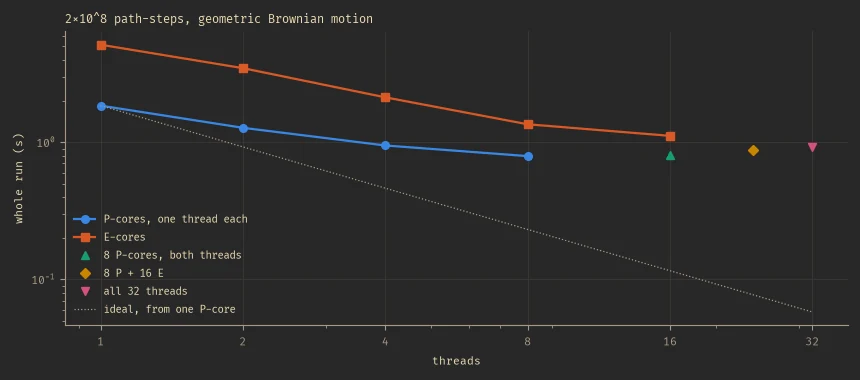
A single performance core finishes in 1.85 s, corresponding to $1.1 \times 10^8$ path-steps per second. Adding performance cores speeds execution up by 1.45 at two cores, 1.95 at four, and 2.33 at eight. Neither hyperthreads nor efficiency cores yield further gains: sixteen efficiency cores reach a factor of 1.66, and enabling all 32 hardware threads reaches 2.0, trailing eight bare performance cores.
Schemes, precision, and statistics
All five numerical schemes carry nearly identical cost because higher-order schemes require no additional random numbers per step beyond Euler–Maruyama. On the CPU, the base geometric Brownian motion runs in 0.47 s across all five schemes in float32 and 0.65 to 0.69 s in float64, with a 2% to 10% spread across schemes on the coupled and Lorenz-96 systems. On the GPU, the five schemes take 2.8 to 2.9 ms in float32 and 41 to 52 ms in float64.
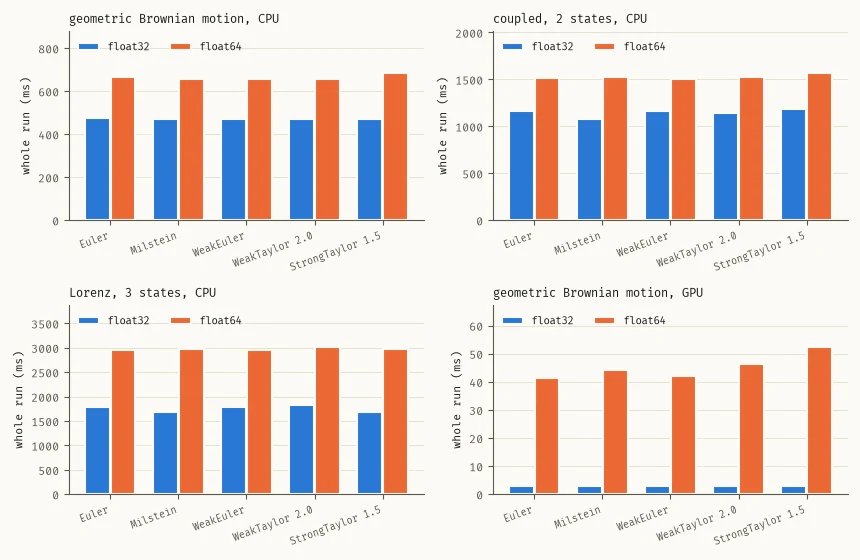
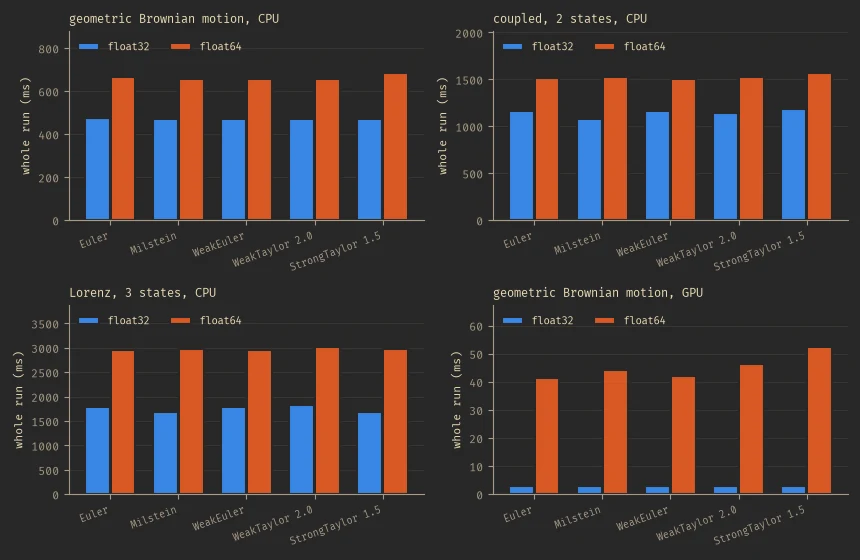
Single path functionals add minimal overhead. Applying a smooth transform, running integral, running maximum, or first-passage statistic increases total run time by 4% to 11%, exporting full trajectories instead of terminal averages adds 13%, and computing a quantile adds 1%. Evaluating multiple statistics in parallel scales more steeply, with four statistics costing 1.5 times one and sixteen statistics costing 3.7 times one.
Operation costs
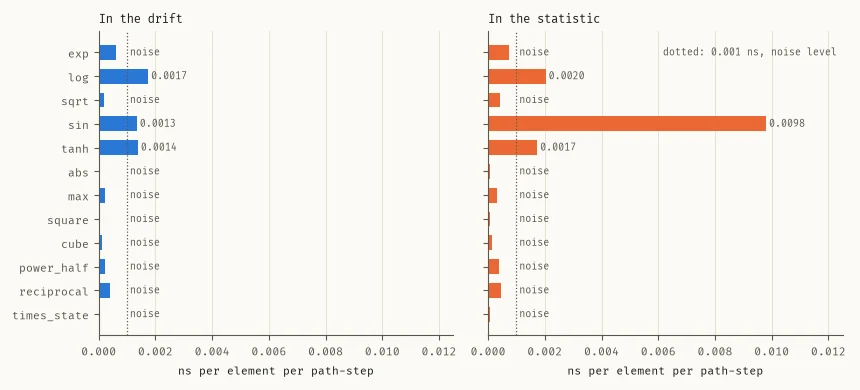
To isolate per-operation runtime cost, each benchmark constructs an additive block of $n = 32$ terms $\varepsilon f(u_k)$ with distinct arguments $u_k$ inside either the drift or the statistic, subtracts the identity-function baseline, and divides by 32. CPU sweeps follow the default protocol, while GPU sweeps run $10^5$ paths over $10^3$ steps in float32, ranging from 8.1 ms at baseline to 40 ms at peak, with up to 5.5% run-to-run variation placing GPU element differences below 0.001 ns within measurement noise.
| Operation | CPU, ns/element | GPU, ns/element |
|---|---|---|
| Square, cube, product | $\le 0.005$ | $< 0.001$ |
| Absolute value on $u > 0$ | $0.007$ | $< 0.001$ |
Reciprocal, max, sqrt | $0.017\text{–}0.031$ | $< 0.001$ |
exp | $0.07$ | $< 0.001$ |
tanh | $0.07\text{–}0.08$ | $0.0013\text{–}0.0020$ |
log | $0.10$ | $0.0013\text{–}0.0020$ |
sin in drift | $0.24$ | $0.0013\text{–}0.0020$ |
sin in statistic | $0.63$ | $0.0098$ |
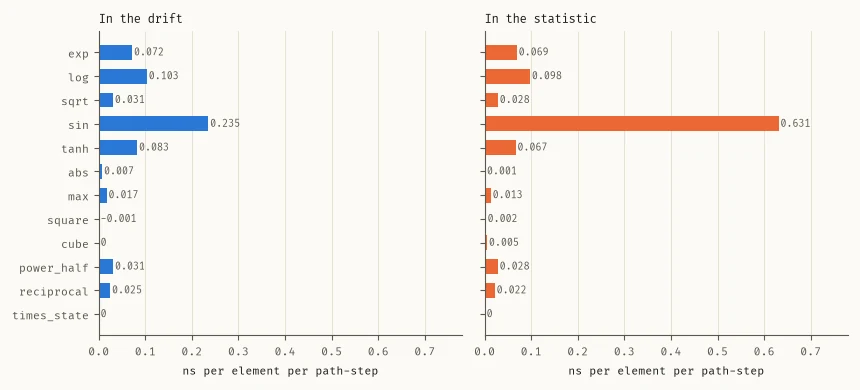
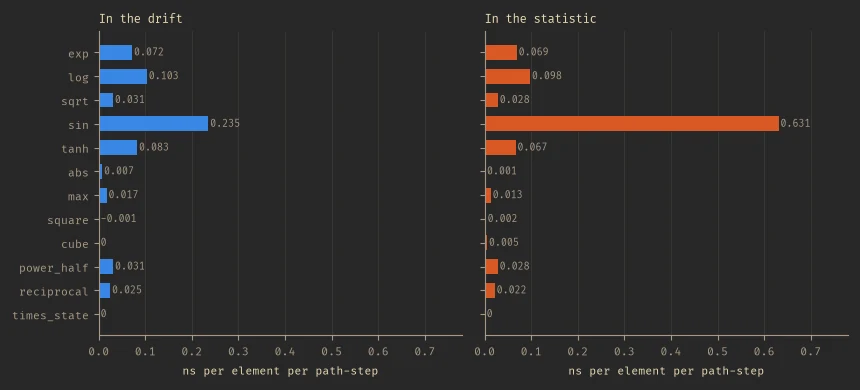
On the CPU, one sin call per step in a statistic adds 13% to the 4.7 ns random-number cost. Vectorized polynomial approximations evaluate exp, log, and tanh, whereas sin and cos dispatch scalar system-library calls, making them roughly six times slower than exp in standalone $10^8$-element sweeps. In the drift, symbolic simplification algebraically folds the 32 sine terms into 10 products of sines and cosines, halving drift cost relative to statistics on the CPU and leaving statistic sin seven times costlier than drift sin on the GPU. For log, tanh, and sin, the GPU is 38 to 174 times cheaper per element than the CPU.
Derivatives
Sensitivities with respect to $n$ initial values and parameters compare compiled automatic differentiation against bump and revalue with common random numbers. On the CPU, automatic differentiation costs 1.1 to 1.8 times the plain run for up to 8 inputs and 3.2 to 3.8 times at 24 inputs, whereas bump and revalue requires $n + 1$ runs. On the GPU, automatic differentiation multiplies plain cost by 1.4 to 3.0 up to 8 inputs and 6.0 at 24 inputs. A full comparison across models, schemes, statistics, and numerical accuracy is given in the sensitivity benchmark article.
Accuracy
Execution speed does not determine discretization accuracy. For the base geometric Brownian motion, the exact terminal mean is $e^{\mu} = 1.6487$ while an $N$-step Euler scheme returns $\left(1 + \frac{\mu}{N}\right)^N$, yielding $O\left(\frac{1}{N}\right)$ weak error.
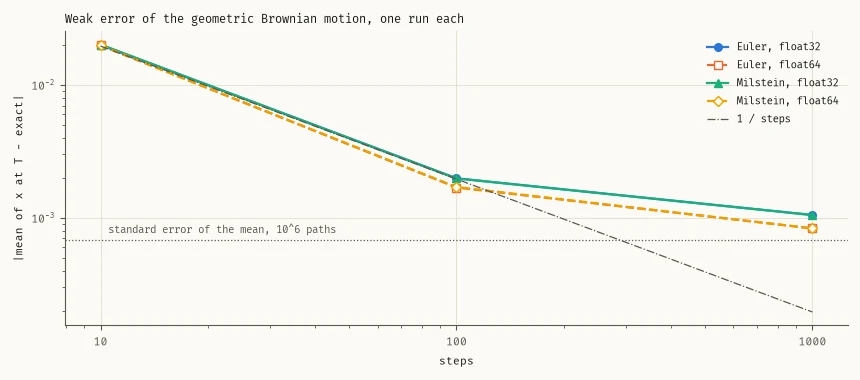
The measured weak error matches theory at 0.0200 for 10 steps and 0.0019 for 100 steps, dropping to the sampling standard error of $7 \times 10^{-4}$ for $10^6$ paths by 1,000 steps. Because the Milstein correction term has mean zero and float32 rounding stays far below sampling variance, Euler and Milstein produce matching errors in both float32 and float64.
Measurement limits
All measurements come from one desktop machine and one consumer GPU. CPU package temperatures reached 90 to 98 °C during heavy sweeps without per-core clock telemetry. Sweeps stop at $10^9$ path-steps on the CPU and $1.1 \times 10^9$ path-step-states on the GPU, while GPU workloads below $10^7$ path-steps remain launch-bound. Compile timings reflect a single run per model, symbolic scaling covers the four functions tabulated above, and per-operation GPU timings carry a 0.001 ns noise floor.